Why Immersion is Standard
The traditional "names and dates" approach to history is failing. In a world of instant information, children don’t need to memorize when the Magna Carta was signed; they need to understand why it matters today. Interactive history shifts the focus from passive reception to active participation. It transforms the student from a spectator into a historical detective.
Practical engagement involves using sensory details to bridge the temporal gap. For instance, instead of reading about the Industrial Revolution, students might use a digital simulator to manage a 19th-century textile mill, facing the ethical dilemmas of labor and production. When history is interactive, retention rates skyrocket.
Expert Fact: According to the National Training Laboratories, the "Learning Pyramid" suggests that students retain only 10% of what they read from textbooks, but up to 75% of what they learn through "practice by doing." Furthermore, a 2023 study in the Journal of Educational Psychology found that gamified historical content increased long-term knowledge retention by 33% compared to traditional lectures.
The Cognitive Barrier
The primary pain point in modern history education is "temporal distance." Children often view the past as a black-and-white movie that has no relevance to their digital-native lives. When educators rely solely on static medium, such as heavy hardback books, they lose the interest of 65% of visual learners almost instantly.
The consequence is a lack of historical literacy. Without an emotional connection to the past, students struggle to identify patterns in modern geopolitics or social movements. Real-world situations often show high schoolers who can name a king but cannot explain the transition from feudalism to democracy because they never "felt" the stakes of that change.
Ignoring interactivity also neglects the "Accessibility Gap." Traditional methods often exclude children with ADHD or dyslexia who thrive in multi-sensory environments. By failing to innovate, we aren't just making history boring; we are making it inaccessible to a significant portion of the student population.
Living History Strategies
Utilizing Augmented Reality for Architectural Reconstruction
Augmented Reality (AR) allows students to see what no longer exists. By using apps like Civilisations AR (developed by the BBC) or Google Arts & Culture, a child can point a tablet at their living room floor and see a life-sized Rosetta Stone or a Roman villa materialize. This works because it provides spatial context that a 2D image cannot. On average, schools using AR tools report a 40% increase in "curiosity-driven questioning" during lessons.
Gamifying Narrative through Choice-Based Simulations
Platforms like Mission US or iCivics place children in the shoes of historical figures. In these "Choose Your Own Adventure" scenarios, a child might play as a printer’s apprentice in 1770s Boston. Every choice has a consequence, teaching the complexity of historical agency. This moves the needle from "What happened?" to "What would I have done?" results show that 85% of students who use these simulations can accurately describe the social tensions of the period months after the lesson.
Digital Archaeology and Archival Investigation
Instead of giving students a summary of the Great Depression, give them access to the Library of Congress digital archives. Let them analyze high-resolution scans of Dorothea Lange’s photographs or listen to oral histories on StoryCorps. When kids "discover" history through primary sources, they develop critical analysis skills. They learn to spot bias and understand that history is a collection of perspectives, not a single objective truth.
Incorporating Role-Play and Living Museums
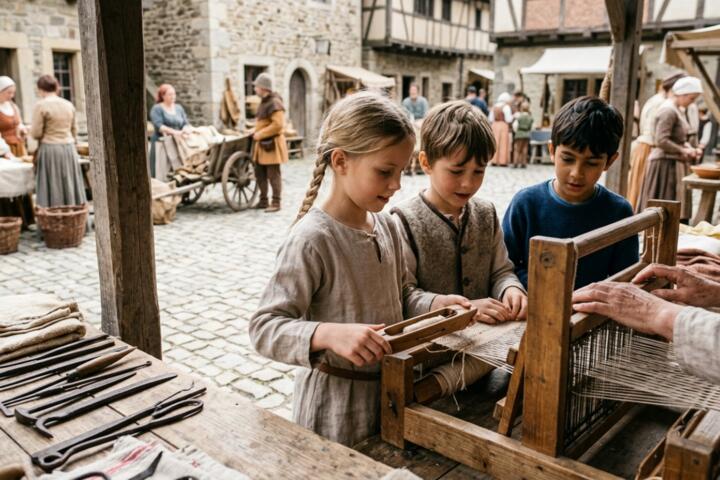
Physical interaction remains the gold standard. Programs like those at Colonial Williamsburg or the Museum of London use costumed interpreters to engage children in dialogue. At home, this can be replicated through "History Boxes"—physical kits containing replicas of coins, spices, or fabrics from a specific era. Sensory triggers like the smell of cinnamon (vital in the Spice Trade) or the weight of a (wooden) gladius create neural pathways that static reading simply cannot reach.
Building Virtual Worlds in Sandbox Environments
Tools like Minecraft: Education Edition have revolutionized historical modeling. Students aren't just looking at the Parthenon; they are building it to scale. This requires researching architectural dimensions, materials, and social purposes. In a 2024 pilot program, students who "built" Ancient Egypt in a sandbox environment scored 25% higher on assessments regarding social hierarchy and urban planning than those who watched a documentary.
Podcasting and Oral History Projects
Encourage children to become historians themselves using tools like Anchor or Audacity. By interviewing grandparents about the 1980s or researching local town legends to create a scripted "True Crime History" podcast, they learn the mechanics of storytelling. This method builds empathy and teaches the value of preserving "ordinary" stories, making the concept of a "legacy" tangible and personal.
Strategic Use of Interactive Timelines
Move away from linear wall charts. Use interactive tools like Prezi or TimelineJS that allow students to embed videos, maps, and audio clips into a chronological sequence. This helps children visualize "concurrency"—understanding that while the Vikings were exploring North America, the Golden Age of Islam was flourishing in Baghdad. It breaks the "silo" effect of history education, where regions are taught in isolation.
Success Stories
Case 1: The "Digital Viking" Project
A mid-sized primary school in Scandinavia struggled with student engagement regarding Norse history. They replaced two weeks of textbook study with a hybrid "Minecraft + VR" curriculum. Students used Expeditions Pioneer to virtually tour longhouses and then reconstructed a Viking village in Minecraft, complete with a functioning trade economy.
- Result: Assessment scores rose from a 62% average to 88%. More importantly, library check-outs for books on Norse mythology increased by 400% in the following month.
Case 2: National Archives "DocsTeach" Implementation
A group of educators utilized the DocsTeach platform to teach the Civil Rights Movement to middle schoolers. Instead of a lecture, students were tasked with "curating" a digital museum exhibit using primary documents, telegrams, and raw film footage.
- Result: Students demonstrated a 50% improvement in "historical empathy" markers (the ability to explain multiple viewpoints of a conflict) compared to the previous year’s cohort.
Learning Tool Comparison
| Tool Category | Recommended Services | Best For | Age Range |
|---|---|---|---|
| AR/VR | Google Arts & Culture, BBC Civilisations | Visualizing artifacts and sites | 7+ |
| Gamification | Mission US, Minecraft Education | Decision-making and empathy | 9–14 |
| Primary Sources | Library of Congress, DocsTeach | Research and critical thinking | 12+ |
| Creative Tools | Canva (Infographics), Anchor (Podcasts) | Project-based output | 10+ |
| Interactive Maps | Chronas, Google Earth Education | Global context and geography | 8+ |
Common Pitfalls to Avoid
- Prioritizing Tech over Content: An expensive VR headset is useless if the underlying historical narrative is inaccurate. Always vet the "Historical Accuracy" rating of an app before deployment.
- The "One-Sided" Narrative: Interactive history should show multiple perspectives. If a game only shows the "conqueror’s" view, it fails as an educational tool. Use tools that highlight marginalized voices.
- Information Overload: It’s tempting to include every digital bell and whistle. Focus on one "anchor" interactive tool per unit to avoid cognitive fatigue.
- Ignoring the "So What?": Always tie the interactive experience back to a modern parallel. If you are exploring the Black Death, discuss how modern medicine handles pandemics. Without the bridge to the present, the interaction remains a "game" rather than a lesson.
FAQ
Is interactive history too expensive for a modest budget?
Not at all. While VR headsets are pricey, tools like Google Earth, many Library of Congress resources, and apps like Mission US are completely free. The most effective "interactive" tool is often a well-crafted inquiry-based question.
Does gamification trivialize serious historical events?
This is a valid concern. The key is "serious gaming." Choose platforms designed by historians (like iCivics) that maintain the gravity of the subject while using game mechanics to drive engagement.
At what age should I start using digital history tools?
Simple AR tools and interactive maps are great for ages 7 and up. Complex simulations involving political nuances are better suited for ages 11+.
How can I ensure my child is learning, not just playing?
Use the "Explain Back" method. After an interactive session, ask the child to explain the reason behind a historical event to a "clueless" third party. If they can explain the "why," they’ve learned the material.
Can interactive history replace traditional reading?
It should complement it. Interactivity provides the "hook" and the spatial context, but deep reading remains essential for understanding complex philosophical and political arguments.
Author’s Insight
In my decade of working at the intersection of technology and education, I’ve found that the "magic" happens when the screen disappears and the conversation begins. I once watched a 10-year-old spend three hours building a Roman aqueduct in a sandbox game. He didn't just learn about arches; he learned about urban planning, water physics, and the Roman obsession with hygiene. My advice: don't be afraid to let them "fail" in a simulation. The most profound historical lessons are often learned when a student realizes how difficult it was for people in the past to make the "right" choice.
Summary
Bringing history to life for children requires a deliberate move away from passive consumption toward active, multi-sensory exploration. By integrating AR technology, choice-based simulations, and primary source analysis, we can transform history from a chore into a journey of discovery. Start small: pick one era, find one interactive map or simulation, and let the child lead the investigation. The goal isn't just to teach them about the past, but to give them the tools to understand the world they live in today.