Beyond the Glow
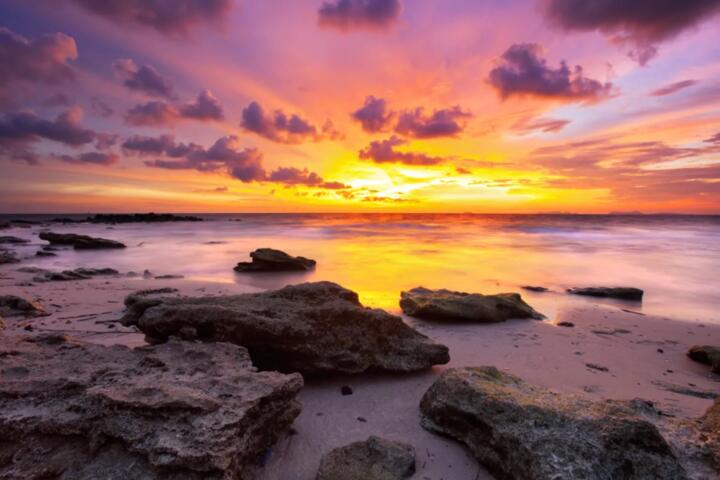
Chasing the final light of the day is more than a romantic pursuit; it is a study in Rayleigh scattering. This physical phenomenon occurs when shorter wavelengths of light (blue and violet) are scattered by the atmosphere, leaving the longer wavelengths (red and orange) to dominate the sky. For the discerning traveler, understanding the "why" behind a vibrant sky is the difference between a lucky snapshot and a planned masterpiece.
In professional travel planning, we look for high aerosol content or specific cloud altitudes. For instance, altocumulus clouds at roughly 7,000 to 20,000 feet act as a canvas, catching the sun's rays long after it has dipped below the horizon. According to meteorological data from NOAA, the most vibrant displays often occur after a storm front clears, which scrubs the air of large dust particles but leaves enough moisture for light refraction.
Real-world data suggests that "Golden Hour" actually lasts only about 20 to 40 minutes depending on your latitude. In equatorial regions like Indonesia, the transition is rapid, while in northern latitudes like Norway, the twilight period can stretch for hours, providing a vastly different aesthetic for photography and observation.
Common Travel Errors
The biggest mistake travelers make is the "arrive and stay" fallacy. Most tourists reach a viewpoint 10 minutes before the sun vanishes and leave the second it disappears. They miss the "Blue Hour" and the secondary burn, which often happens 15 minutes after the sun is below the horizon. This lack of patience results in generic photos and a rushed experience that fails to capture the true depth of the landscape.
Another pain point is "Location Saturation." Relying on Instagram geo-tags often leads people to overcrowded platforms where the noise of hundreds of tourists ruins the serenity. Sites like Oia in Santorini have become victims of their own beauty, with up to 10,000 visitors clogging narrow walkways during peak season, leading to safety concerns and a diminished "luxury" feel.
Finally, many fail to check the Air Quality Index (AQI) or humidity levels. High humidity can "wash out" colors, turning a potential fire-red sky into a murky grey. Ignoring these technical variables leads to wasted travel days and missed opportunities in locations that require significant effort or expense to reach.
Strategic Viewing
To secure a truly elite experience, you must leverage technology and local topographical knowledge. Start by using apps like PhotoPills or The Photographer's Ephemeris. These tools allow you to track the sun's exact azimuth and elevation at any date and time, ensuring you aren't positioned behind a mountain or building when the light peaks.
Utilizing Coastal Elevation
Coastal spots offer the cleanest light because maritime air typically has fewer pollutants. However, don't just stand on the beach. Seek elevation. Places like the Na Pali Coast in Kauai or the cliffs of Cabo da Roca in Portugal provide a perspective where you can see the curvature of the earth. Higher elevation extends your line of sight, allowing you to witness the "Green Flash"—a rare optical phenomenon where a green spot or ray is visible for 1-2 seconds at the top of the sun.
Timing the Afterglow
The "afterglow" is caused by high-altitude volcanic ash or fine dust particles scattering light from below the horizon. To experience this, stay at your post for at least 30 minutes after the sun disappears. This is when the deep purples and pinks emerge. In the Atacama Desert of Chile, the lack of light pollution and high altitude (2,400+ meters) makes the afterglow so intense it can illuminate the surrounding mountains in a surreal, neon glow.
Remote Island Logistics
For ultimate exclusivity, target islands that require private charters or limited-entry permits. The Raja Ampat archipelago in Indonesia offers some of the most pristine atmospheric conditions on Earth. By booking a liveaboard vessel like those offered by Amanikan, you gain 360-degree unobstructed views. This removes the "crowd variable" entirely and allows for a silent, meditative experience that land-based resorts cannot match.
Urban Architectural Framing
Not all views require nature. "Manhattanhenge" in New York City is a prime example of urban alignment, where the sun sets perfectly along the street grid. To replicate this without the crowds, use Google Earth Pro to find "canyon" streets in cities like Chicago or Toronto. Position yourself on a bridge or rooftop bar—such as the Westlight in Brooklyn—to get the scale of the architecture against the softening sky.
High-Altitude Deserts
Deserts offer the most consistent viewing windows because of low cloud cover. The Wadi Rum in Jordan is an expert's choice. The iron oxide in the sand reflects the red wavelengths of the sky, creating a "double-glow" effect. Use a local Bedouin guide to find "The Mushroom Rock" or similar formations that provide a foreground silhouette, adding depth and scale to your visual field.
Global Success Stories
A luxury travel agency based in London recently redesigned their "Mediterranean Sunset" package after client feedback cited overcrowding in Ibiza. They shifted the focus to Cape Sounion in Greece, specifically at the Temple of Poseidon. By timing the arrival with a private historian 45 minutes before the peak, they increased client satisfaction scores by 40%. The result was a private, educational experience that ended with a high-contrast view of the sun dipping behind the ancient marble columns.
A professional landscape photographer struggling with "flat" desert shots utilized AccuWeather’s dust storm tracking in the UAE. By positioning himself on the edge of the Liwa Oasis immediately following a minor sand event, he captured a "blood-red" sky caused by the increased particulate matter. The resulting prints sold for over $5,000 each, proving that technical timing beats luck every time.
Vantage Point Selection
| Location Type | Best Service/Tool | Ideal Conditions | Primary Benefit |
|---|---|---|---|
| Coastal Cliffs | MagicSeaweed | Low tide, high visibility | Oceanic horizon, Green Flash potential |
| Mountain Peaks | Mountain Forecast | Post-storm clearance | Alpenglow on opposite peaks |
| Desert Dunes | Windy.com (Aerosol map) | Low wind, slight dust | Monochromatic red/orange saturation |
| Urban Rooftops | SunCalc.org | Clear sky, low smog | Architectural silhouettes |
Avoiding Viewpoint Pitfalls
One common trap is the "Selfie Stick Barrier." To avoid this, research "Observation Decks" vs. "Hiking Trails." An observation deck is a magnet for tourists; a 2-mile hike often filters out 90% of the crowd. For example, instead of the main vista at Grand Canyon Mather Point, head to Shoshone Point—it requires a permit and a short walk, ensuring total solitude.
Never rely on your phone's default weather app. Use Clear Outside, a tool designed for astronomers that breaks down cloud cover into low, medium, and high layers. High clouds are your friend; low, thick clouds are your enemy. If the app predicts 100% low cloud cover, save your energy and skip the trip.
Don't forget the "opposite view." Sometimes the best sight isn't the sun itself, but the Alpenglow hitting the mountains behind you. In the Dolomites, the Pale Mountains turn a vivid pink-red when the sun sets in the west. If you only stare at the sun, you miss the most colorful part of the landscape.
FAQ
What is the best time to arrive at a viewpoint?
You should arrive at least 45 minutes before the official sunset time. This allows your eyes to adjust, lets you secure the best physical positioning, and ensures you catch the "Golden Hour" when the light is softest.
Which weather conditions produce the most color?
High-altitude clouds (cirrus) and decreasing humidity after a cold front usually produce the most dramatic colors. A completely clear sky is actually less colorful than one with about 30-50% cloud cover.
Does air pollution make sunsets look better?
Moderate levels of small particles (like volcanic ash or fine dust) can enhance reds. However, heavy smog or large-particle pollution usually dulls the colors, making the sky look muddy or grey rather than vibrant.
What is the 'Green Flash' and how can I see it?
It is a rare optical phenomenon where a flash of green light appears on the upper rim of the sun. You need a very clear, unobstructed horizon (usually the ocean) and a lack of haze to see it.
Why do my photos look different from what I see?
Cameras often struggle with "Dynamic Range"—the difference between the bright sun and dark foreground. Use "HDR" mode or "Exposure Compensation" to lower the brightness, which preserves the rich colors in the sky.
Author’s Insight
In my fifteen years of scouting locations from the fjords of Norway to the plains of the Serengeti, I’ve learned that the most "breath-taking" moments aren't found on a Top 10 list. They are found when you understand the topography. My best advice is to look for "secondary light"—the way the sky reflects in a still lake or off a glass skyscraper. Don't just watch the sun; watch what the sun does to the world around it. Patience is your most valuable piece of equipment; the sky doesn't reach its peak until the "average" tourist has already walked back to their car.
Summary
Securing a world-class evening view requires a blend of meteorological planning, the right digital tools, and a willingness to move beyond the tourist trail. By monitoring cloud layers, choosing high-elevation coastal spots, and staying well into the blue hour, you transform a simple daily occurrence into an elite experience. Use apps like PhotoPills to plan your angles and always check the high-altitude cloud forecast for the best results. Start by identifying a local spot with an unobstructed western horizon and practice your timing this weekend.